The most important factor in ordering frozen oysters is selecting a product that matches your intended volume and cooking method. If the packaging unit does not align with your usage, you may end up with leftover thawed oysters or unnecessary additional work. You must also consider whether they are raw or blanched, check product labeling, and verify the usable yield after thawing.
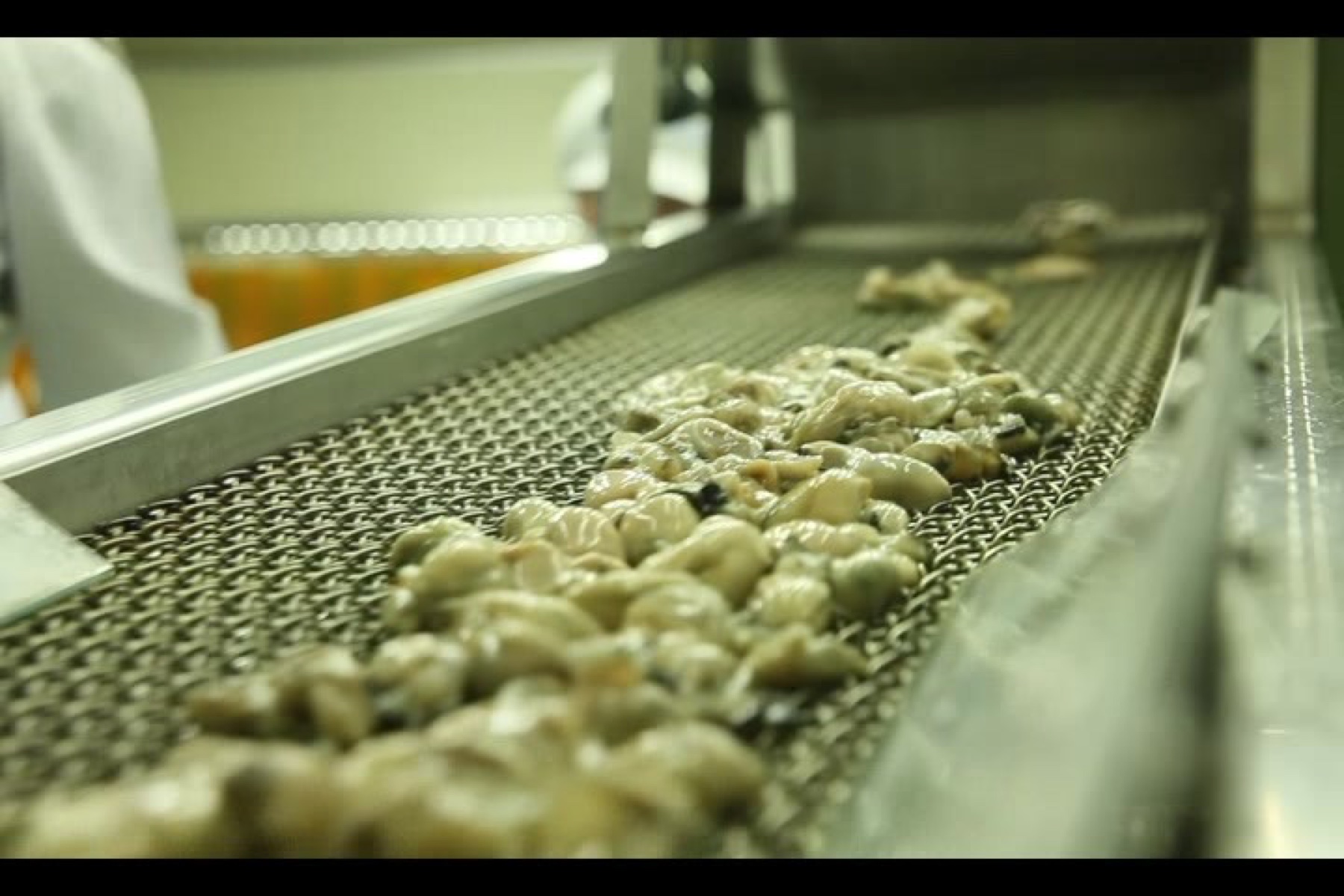
Photo of the oyster sorting process provided by Samsam Mulsan.
Photo credit: Samsam Mulsan
Frozen oyster specifications are divided into four categories
Since product names often combine various conditions, you should read them by breaking them down into freezing method, heat treatment, product form, and surface treatment.
|
Evaluation Criteria |
Representative Options |
Questions to Answer Before Ordering |
|
Freezing Type |
IQF, Block Frozen |
Will you separate only the required amount, or use the entire package in one batch? |
|
Heat Treatment Status |
Raw, Blanched |
What heating and cooking processes will be used at the store or manufacturing site? |
|
Product Form |
Shucked Meat, Half-shell, etc. |
Is the shell or a specific appearance necessary for the menu composition? |
|
Surface Treatment/Labeling |
Glazed or Unglazed, Net Weight |
By what criteria will you verify the actual product weight excluding the ice glaze? |
For example, ‘Blanched IQF Shucked Oysters’ refers to heat-treated oyster meat frozen individually, while ‘Raw Block Frozen Shucked Oysters’ refers to unheated oyster meat frozen together in a single mass. Therefore, when choosing frozen oysters, it is advisable to look at both the freezing method and whether they have been heat-treated.
IQF, Block Frozen, and Blanched are not options based on the same criteria
|
Category |
Core Characteristics |
Operational Value |
Considerations for Use |
Checklist Items |
|
IQF |
Frozen individually in separate pieces |
Easy to take out only the required quantity |
If the entire package is used at once, the advantage of individual portions is minimal |
Clumping, size range, packaging unit |
|
Block Frozen |
Multiple pieces frozen together in one mass |
Can simplify batch-unit input and packaging management |
Frequent small orders may lead to leftover thawed inventory |
Block weight, thawing time, handling of leftovers |
|
Blanched Frozen Oysters |
Products frozen after heat treatment |
Suitable for menus requiring pre-cooked ingredients |
Not suitable if raw oyster characteristics are needed or if onsite processes conflict with heating instructions |
Degree of heating, intended use, consumption/additional heating instructions |
The FAO describes IQF products as a form that can be separated into individual units without thawing the whole. In your purchasing review, first decide between raw or blanched status, then choose between IQF or Block based on your usage unit. Checking the boundary of use between blanched and raw oysters will also help prevent mistaking a ‘blanched’ label for a ‘ready-to-eat’ label.
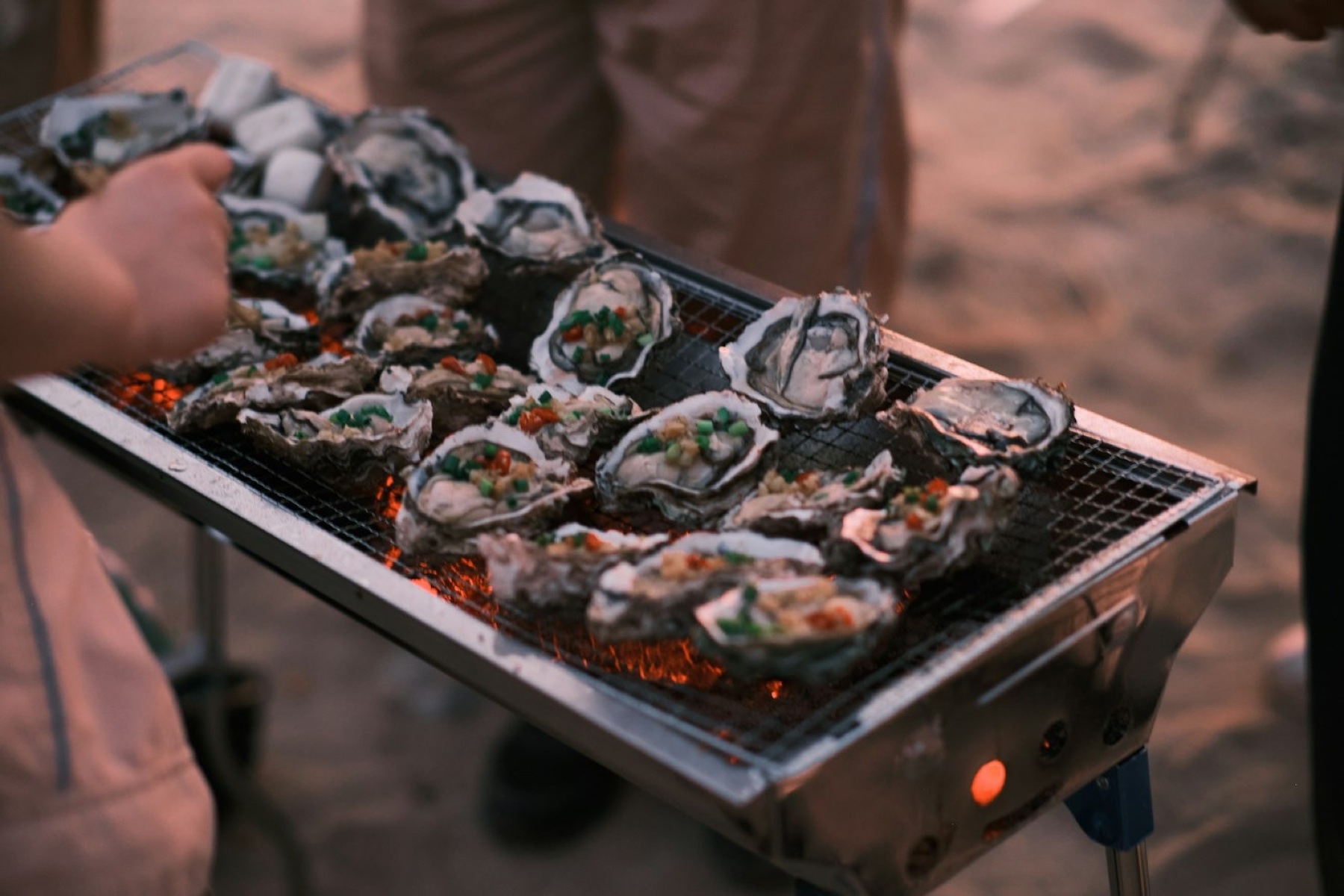
Example of an oyster cooking preparation scene.
Photo: LI WEIBIN / Unsplash · License
Choosing Frozen Oysters That Match Your Menu and Usage Volume
First, determine the menu items and the quantity needed at one time, then compare cooking methods and packaging units. Once candidate products are selected, test them under identical conditions and establish the specifications for ordering and the items to be verified upon delivery.
-
Determine the menu and the quantity needed at one time. Distinguish whether the number of oysters used varies by order volume, such as for oyster pancakes, pasta, jjamppong, oyster rice, or toppings, or if large quantities are used at once, such as for soups, stews, sauces, pastes, or fillings.
-
Choose between raw or blanched based on the cooking method. Blanched oysters can be considered for stir-fries, toppings, or processed food formulations requiring pre-heated ingredients, but you should not assume they are ready for immediate consumption based on the product name alone. Before use, you must check the consumption method and additional heating instructions on the product label.
-
Check if the packaging unit matches the amount to be used at one time. If the block is larger than the required amount, thawed oysters will be left over; if it is too small, you will have to open multiple packages. IQF is convenient for taking out only what is needed, but it does not inherently mean the quality is superior.
-
Compare weights after thawing and cooking under the same conditions. Record the delivery weight, weight after removing the ice glaze, weight after full thawing and draining, and weight after cooking in separate columns.
-
Establish the ordering specifications and the items to be checked upon delivery separately. Since a single test result may not apply identically to every lot, distinguish and organize the conditions to be included in the contract and the items to be verified during delivery.
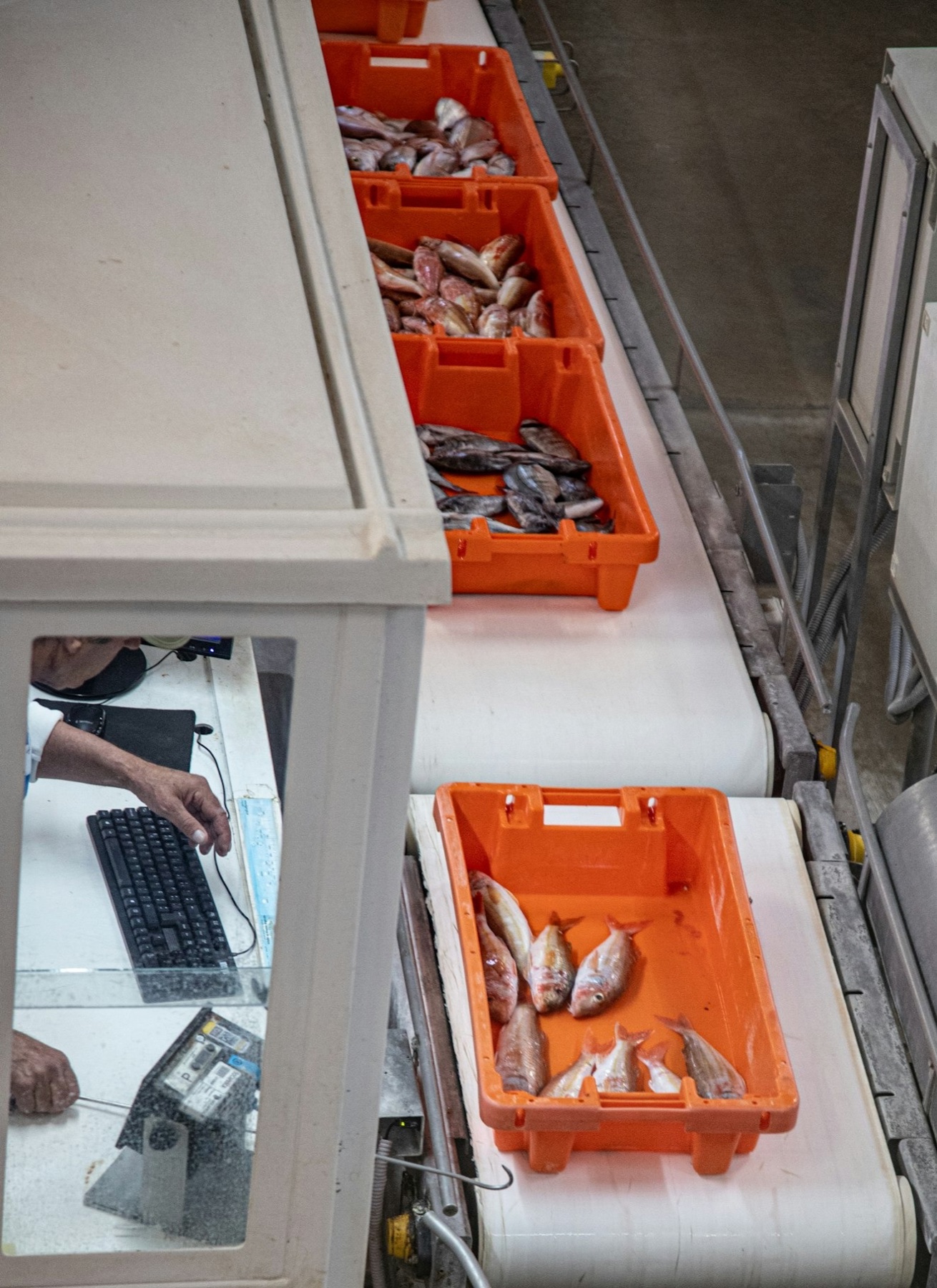
Reference image showing the process of checking the weight of seafood.
Photo: Bernd Dittrich / Unsplash · License
Glaze and Net Weight to Check When Comparing Prices
Glazing is a protective ice film designed to slow down dehydration and oxidation on the surface of frozen oysters. Even though it serves a protective function, the ice film should not be calculated as part of the oyster meat weight. Refer to the difference between glaze and net weight labeling and cross-check with the specification sheet to see if the ice film was excluded from the labeled net weight and what test conditions were used for measurement.
Even if a product has a lower price per package, the actual cost may be higher if the usable amount after thawing is low. The following is a hypothetical example to explain the calculation structure and does not represent the actual price or yield of any specific product.
|
Hypothetical Product |
Purchase Price |
Usage After Thawing/Standard Draining |
Cost per 1 kg of Usable Product |
|
A |
30,000 KRW |
1.70 kg |
30,000 ÷ 1.70 = approx. 17,647 KRW |
|
B |
32,000 KRW |
1.88 kg |
32,000 ÷ 1.88 = approx. 17,021 KRW |
Although the purchase price for A is lower, when calculated by the usable amount after thawing and draining, the cost per 1 kg for B is lower. When comparing actual menu costs, you should also consider the reduction in volume after cooking, the degree of breakage, and the time required for processing. At this time, you must distinguish between water from the melted ice glaze and water released from the oysters during thawing to avoid confusing net weight with usable weight after thawing.
Compare the usable amount after thawing under the same conditions
If thawing temperature, time, and draining time vary, it is difficult to compare the usage of each product on the same basis. Verify the weight after thawing and draining under identical conditions.
-
First, check the thawing and cooking instructions on the packaging. Since thawing is not a sterilization process, you must follow the heating instructions on the product label and the cooking conditions verified on-site when preparing the food.
-
For IQF, take out only the amount needed for testing or cooking and keep the rest frozen.
-
When comparing products, use the same containers and sieves, and ensure the thawing temperature, time, and draining time are all consistent.
-
Use refrigerator thawing, and if thawed in a microwave, cook immediately. Avoid leaving the product in hot water or at room temperature for long periods, and avoid repeated freezing and thawing.
-
Do not press the oysters to drain water or soak them in water for different amounts of time for each candidate.
If the product description permits, some IQF oysters can be added to heated menu items while still frozen, but this rule does not apply to all products. Since adding a large amount can change the broth temperature and cooking time, verify based on the product-specific instructions and standard recipes.
What should be prepared for order forms and supply inquiries?
Place information for each candidate product—such as raw/blanched status, intended use, IQF/block type, product form and size specifications, labeled net weight, glaze management standards, packaging units, storage conditions, expiration date, and lot/origin—into a single table. If testing is possible, record the weight after glaze removal, weight after thawing/draining, weight after cooking, breakage/shrinkage/aroma, and processing time per batch in the same format.
When inquiring about supply from Samsam Mulsan, please let us know the menu items you will use, the amount needed at one time, and your approximate monthly usage. Also, feel free to share any questions regarding the required raw/blanched status, packaging units, product labeling, or yield. Available specifications and terms can be confirmed during the consultation process.
Frequently Asked Questions
Are IQF oysters always better quality than block frozen oysters?
No. IQF is simply a form that is easy to separate into individual pieces to use only the required amount. First, consider the usage volume and appearance requirements for each menu item, then separately compare the raw material status, size variation, storage history, packaging, and thawing/cooking results.
Should block frozen be the first choice for large-scale catering?
If the input amount per batch and the weight of a single block match, it is worth considering. However, if the block is larger than the batch, leftover management is required; if it is smaller, the frequency of opening and handling increases. Make a judgment by comparing the block weight, standard batch input, thawing time, and leftover processing standards side-by-side.
Can blanched oysters be served immediately after thawing?
This cannot be determined by the product name alone. While ‘blanched’ means the product has been heat-treated, whether it is ready-to-eat depends on the product’s labeled use, consumption method, and additional heating instructions. Check the instructions on the label and specification sheet, and review whether the on-site cooking process meets those conditions.
Should products with a lot of glaze be excluded from purchase?
Since glaze serves the function of protecting the product surface during freezing, its presence alone cannot be used as a criterion for rejection. Instead, compare whether the ice film was excluded from the labeled net weight, whether the contract standards and test conditions are clear, and what the actual usable amount is under the same conditions.
Should I look at the price per package or the actual usage cost?
Look at both values, but ensure the menu cost reflects the usage after standard thawing and draining. By dividing the purchase price by the usable weight and recording shrinkage after cooking, breakage, and labor time, you can identify candidates that may have a low price but result in higher on-site costs. If the comparison conditions differ, do not compare the figures directly.
How should size variation be reflected in the order form?
Rather than just writing expressions like ‘Large, Medium, Small,’ include the size range of the supply specifications and the variation in actual delivered items as checklist items. Record the menu appearance, the number of pieces per serving, heating time, and batch uniformity together. Since IQF status and size uniformity are not the same concept, evaluate them separately.
How should I handle signs of thawing or packaging damage upon delivery?
Include packaging condition, frozen state, labeling information, and lot information in the delivery inspection items, and handle them according to the judgment criteria agreed upon with the supplier. Do not re-freeze arbitrarily; instead, record any abnormalities. Specific judgments should prioritize the storage conditions for each product and the contract standards.
Can I put them directly into the cooking process while still frozen?
This cannot be applied collectively to all frozen oysters. You must first check if the product description allows it, and also review in the standard recipe whether the increased input volume will change the broth temperature and cooking time. Regardless of whether it is permitted, the heating instructions on the label and the verified cooking conditions on-site must be maintained.
Can I re-freeze thawed oysters?
Repeated freezing and thawing increases quality changes and complicates handling conditions. Rather than assuming re-freezing is an option, match the single-use amount with the packaging unit of IQF or blocks.
Can a single test result be used as the contract yield?
A single result should not be used as a guaranteed value for all lots. Use tests for comparing candidates under identical conditions, and organize test conditions separately in the contract specifications. In delivery inspections, record the weight after glaze removal, after thawing/draining, and after cooking separately rather than mixing them, so that the cause of yield changes can be identified.
References
-
FAO, Freezing and refrigerated storage in fisheries: Influence of temperature
-
FAO·WHO Codex Alimentarius, Code of Practice for Fish and Fishery Products (CAC/RCP 52-2003)
-
National Fisheries Quality Management Service Seafood Safety Information, Shelf Life and Weight Labeling of Frozen Seafood Products
-
Food Safety Korea, Tips for Purchasing and Storing Seafood
-
FAO·WHO Codex Alimentarius, Standard for Live and Raw Bivalve Molluscs (CXS 292-2008, amended 2026)