Oyster & Seafood Glossary
GLOSSARYTerms that appear on product sheets and purchase orders but are rarely explained anywhere. We keep adding entries.
What is oyster shucking, and how is hygiene managed?
Oyster shucking is the process of opening the shell, separating the adductor muscle, and removing the oyster meat, and is called shucking in English. While both terms are used similarly in the field, it is necessary to check the scope in the specifications to determine if the end product is a half-shell oyster (with one shell remaining) or a shucked oyster (with all shells removed).[1]
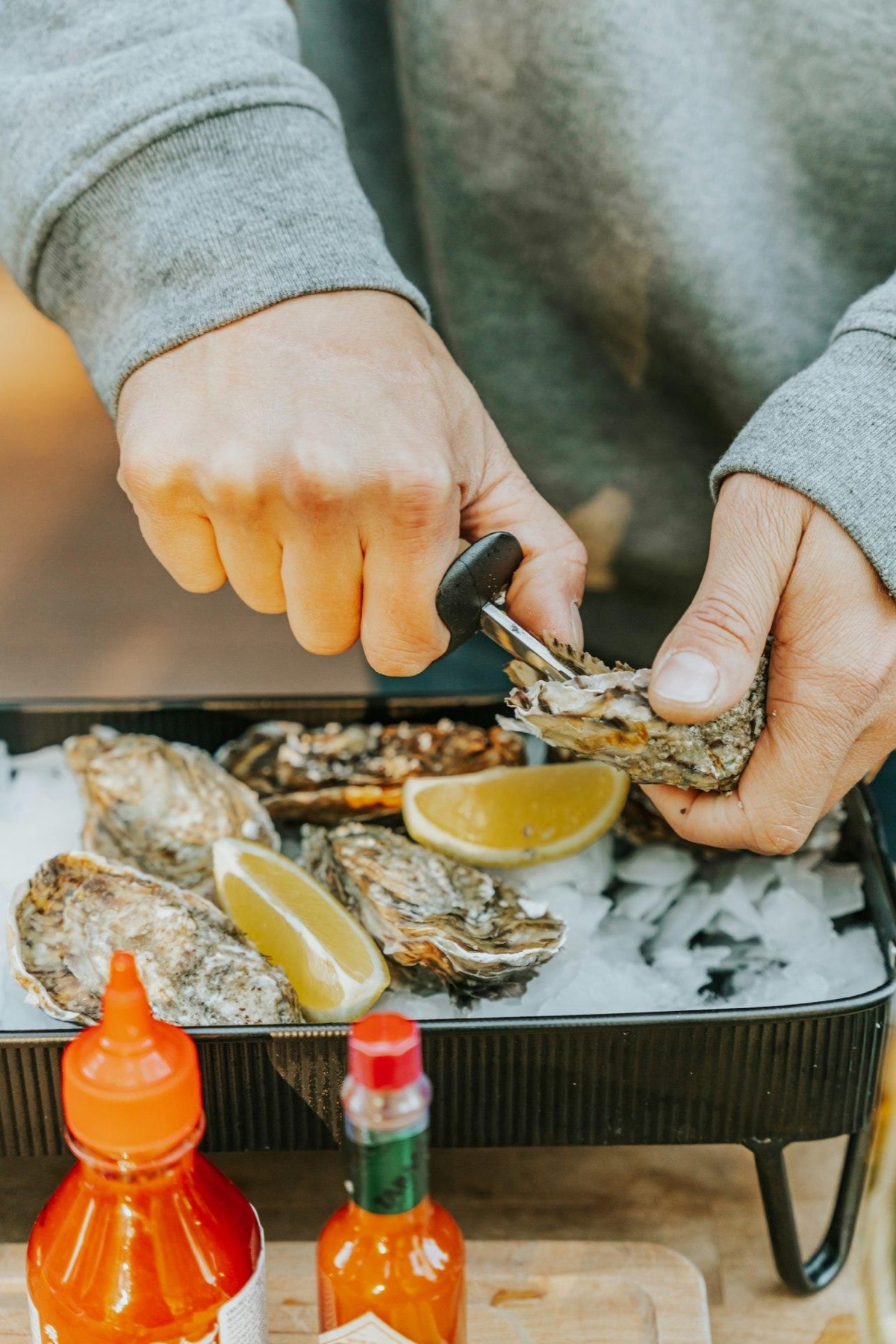
Example of oyster opening. This photo does not show industrial hygiene management standards. It is a stock photo for illustrative purposes and does not certify Samsam Moolsan’s products, facilities, certifications, or Korean-sourced raw materials.
Photo: Oskar Kadaksoo / Unsplash · License
Focus on the results and contact surfaces rather than the method of operation.
Manual shucking involves prying open the shell with an oyster knife and cutting the adductor muscles of both the upper and lower shells. While heat, cold, pressure, or auxiliary tools can facilitate opening, these methods do not explain the hygiene management after shucking or the raw/cooked state. [1] For shape classification, refer to Forms and Labeling of Shucked Oysters and compare actual products with specifications.
Once shucking begins, the oyster meat directly contacts knives, gloves, workstations, and containers, and shell fragments may mix in. Monitoring process water/ice, food contact surfaces, hand hygiene, and cross-contamination prevention are all critical items.[2]
|
Management Point |
Content to Check |
Example Record to Keep |
|
Before Work |
Raw material lot, area separation, worker & tool condition |
Receiving & work start inspection |
|
During Work |
Preventing floor contact, contact surface hygiene, shell removal |
Hygiene rounds & foreign matter sorting records |
|
Time & Temperature |
Movement & cooling after shucking, product condition |
Start & end times, product temperature |
|
After Work |
Cleaning workstation, knives, containers, drains; shell disposal |
Cleaning & sanitization verification |
FAO’s oyster HACCP example links raw material harvesting, cooling, and receiving records with shucking, washing, and packaging stages.[3] Do not judge solely by the name of the processing method; instead, compare contact surface hygiene, time/temperature, and foreign matter records for the same lot.
Manage shell fragments and oyster meat washing separately
Verify in process flow diagrams and records whether shell fragments are sorted immediately after shucking or also inspected after washing and draining. Sampling, acceptable limits, quantity/size of findings, and lot hold/re-sorting procedures should also be compared. Criteria must be set according to product and contract specifications, not by applying arbitrary common acceptance levels.
Washing shucked oyster meat is the process of removing sand, mud, and shell debris, sorting damaged meat, and then draining.[4] Since it differs from depuration of live shellfish, processing of seawater, and its target, it should be distinguished as in Differences in Shellfish Depuration, Seawater Treatment, and Oyster Meat Washing. Washing is not a sterilization process that removes viruses or shellfish toxins from within the tissue. Verify wash water suitability, contact time, draining conditions, and weight records, but do not judge safety or quality solely by the number of repetitions.
Receive supply review documents in lot order
Refer to Oyster Processing Stages by Product and request appropriate documents for half-shell/shucked, raw/cooked states of your purchased SKUs.
- External cleaning before shucking and separation of raw material/oyster meat areas
- Hand hygiene, knife/glove/workstation/container replacement and cleaning standards
- Shucking start/end, movement/cooling times, and product temperature records
- Shell fragment sorting/detection, results, and deviation handling records
- Wash water for oyster meat, contact/draining conditions, and weight linked to lot
When inquiring about supply from Samsam Moolsan, please provide the required half-shell/shucked form, raw/cooked state and intended use, packaging unit, monthly usage, and any necessary hygiene, shell fragment, and time/temperature data. Actual supply specifications and transaction terms must be confirmed upon inquiry.
Frequently Asked Questions
Are shucking and ‘baksin’ different processes?
They are generally used interchangeably, but the scope of half-shell opening and complete shucking may vary by document. Please confirm the final form and process completion point.
Does washing oyster meat multiple times sterilize it?
No. Oyster meat washing is the process of removing surface sand, mud, and shell debris, followed by sorting and draining. Product use and hygiene management must be verified separately.
What standards and records are used to check for shell fragments?
Establish inspection locations, sampling, acceptable limits, and the quantity/size of findings, and confirm that lot holds, re-sorting, and judgment results are documented.
Is one method, manual or machine-assisted, always safer?
It cannot be judged by method alone. Compare contact surface hygiene, area separation, shell removal, and time/temperature management, along with deviation records.
What hygiene and time/temperature records should be requested during process review?
Request records for the incoming lot, work start/end, movement/cooling times after shucking, product temperature, contact surface inspections, washing/draining, and shell fragment results, all linked to the same lot.
Sources and Verification Criteria
[1] FAO Handling and Processing Oysters
https://www.fao.org/4/x5954e/x5954e01.htm
Definition of shucking, manual methods, half-shell processing, and alternative opening techniques · Verified 2026-09-27
[2] 21 CFR Part 123, Fish and Fishery Products
https://www.ecfr.gov/current/title-21/chapter-I/subchapter-B/part-123
Hygiene management for seafood processing, including process water/ice, food contact surfaces, cross-contamination, handwashing · Verified 2026-09-27
[3] FAO Generic HACCP Plan for the Production and Processing of Oysters
https://www.fao.org/4/y4743e/y4743e0t.htm
Example of hazard analysis linking raw material harvesting/cooling/receiving with shucking/washing/packaging · Verified 2026-09-27
[4] 21 CFR Part 161, Fish and Shellfish, Section 161.130 Oysters
https://www.govinfo.gov/content/pkg/CFR-2020-title21-vol2/pdf/CFR-2020-title21-vol2-part161.pdf
Example product standards for washing shucked oysters, water contact, and draining · Verified 2026-09-27