Oyster & Seafood Glossary
GLOSSARYTerms that appear on product sheets and purchase orders but are rarely explained anywhere. We keep adding entries.
Shucked Oysters (Al-gul/Kkan-gul): Form and Labeling
Al-gul or Kkan-gul refers to a product form where only the oyster meat is separated after removing the shell. In English, this is called oyster meat or shucked oyster.[1][2] This term alone does not indicate whether the product is refrigerated or frozen, raw or cooked, for raw consumption or cooking, or its weight standard. To apply the same criteria for quotations and incoming inspections, the purchase order must specify not only the form but also other attributes.
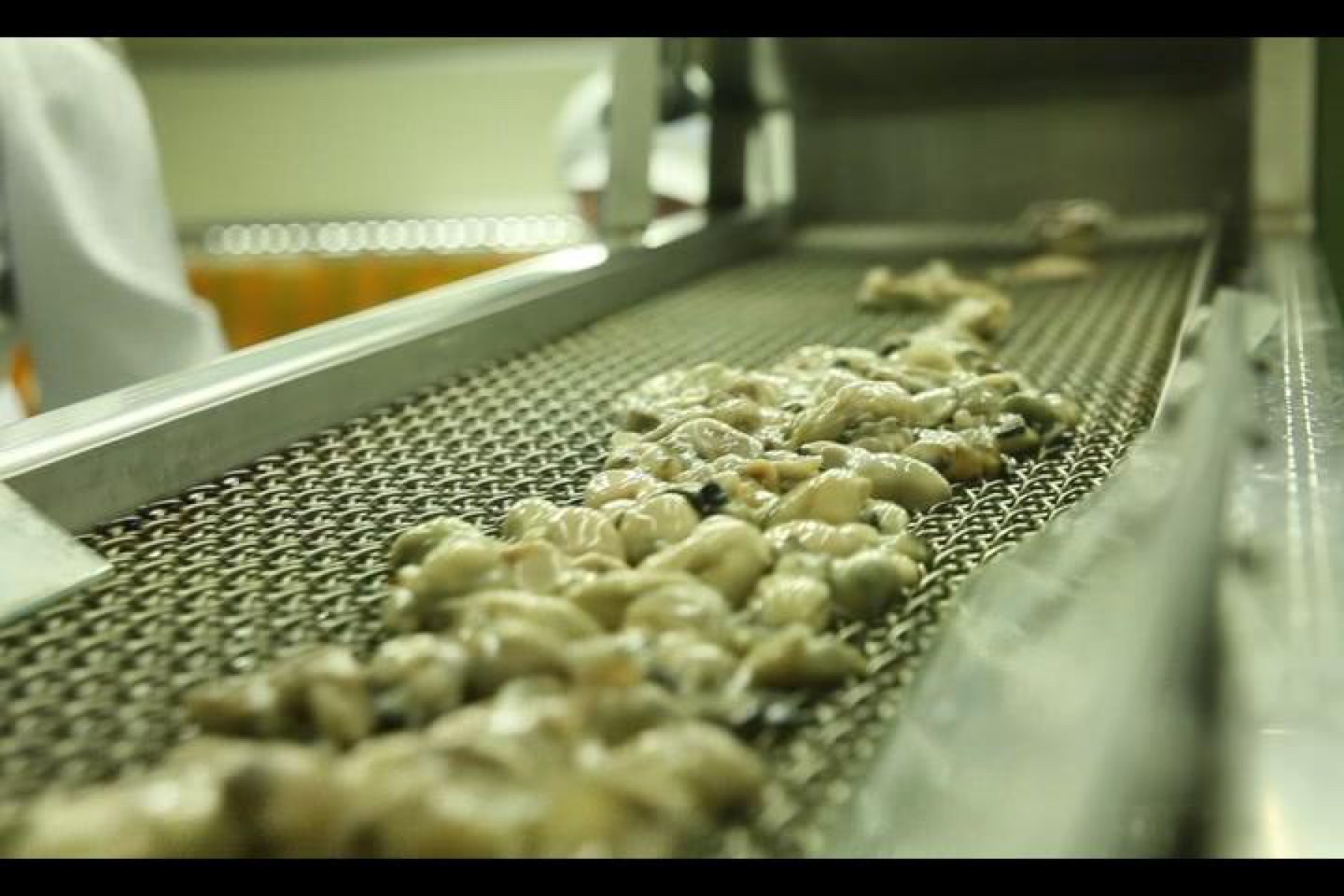
Photo provided by Samsam Moolsan from the oyster sorting process. The refrigeration, freezing, or cooking status and sorting specifications of the product should be confirmed in the product specification sheet.
Photo Credit: Samsam Moolsan · Original provided by company
How do they differ from Whole Shell Oysters and Half-Shell Oysters?
|
Term |
Shell Condition |
Distinguishing Criteria |
|
Whole Shell Oysters (Gak-gul/Seok-hwa) |
Both shells maintained |
Distributed with shells intact |
|
Half-Shell Oysters |
One shell maintained |
Oyster meat placed on the bottom shell |
|
Shucked Oysters (Al-gul/Kkan-gul) |
No shell |
Only separated oyster meat is distributed |
Al-gul and Kkan-gul are not product names or cooking states. The same Al-gul can be refrigerated raw oysters, raw oysters for cooking, IQF frozen oysters, or cooked frozen oysters. Bagged packaging is a separate condition and can be distinguished in Understanding the Meaning and Labeling of Bagged Oysters.
Confirm post-shucking processes and shell fragments.
Shucking or shelling is the process of opening the shell and cutting the adductor muscle to separate the oyster meat. Afterward, shell fragments and foreign matter are removed, followed by sorting, washing, and draining, before being refrigerated and packaged or sent for cooking/freezing processes. For processes to review, refer to Glossary of Oyster Shucking/Shelling Terms and Oyster Processing Procedures, but actual implementation steps should be confirmed with the product-specific process flow diagram.
After shucking, contact with knives, gloves, workstations, containers, and process water increases. Food contact surfaces, hand hygiene, prevention of cross-contamination, and low-temperature management are separate management considerations.[3] For shell fragments, request and confirm the sorting/inspection location in the process flow diagram, permissible standards, lot records, and deviation handling procedures.
Items to include in the purchase order besides the product name
- Heat Treatment Status: Raw or Cooked
- Storage Temperature: Refrigerated or Frozen
- Intended Use: For raw consumption, for further cooking, ready-to-eat, etc., as indicated per product
- Freezing Form: IQF, Block, etc.
- Weight Standard: Net weight, drained weight, or water-holding capacity and measurement method
- Product Specifications: Size range, count per unit weight, packaging unit
- Storage Information: Storage temperature and date marking
- Foreign Matter Standard: Permissible standard for shell fragments and incoming inspection method
The absence of shells or washing does not automatically make oysters suitable for raw consumption. The ‘for cooking’ label provides information defining the method of use. The Ministry of Oceans and Fisheries also explains cases where oysters under management in production areas were distributed with a ‘for cooking’ label.[4] Please check the SKU-specific labels and specification sheets.
Convert to comparable specification statements
In the purchase order, instead of ‘Kkan-gul’, specify attributes separately, such as ‘Frozen Al-gul for cooking, raw material, IQF, net weight standard, size range, packaging unit, shell fragment allowance’. Net weight, drained weight, and water-holding capacity have different meanings, so define which weight is being referred to and specify drainage conditions.
When inquiring about supply from Samsam Moolsan, please provide information on raw/cooked status and intended use, refrigerated/frozen status and IQF/block form, size/weight measurement methods, single input quantity, monthly usage, packaging unit, and permissible shell fragment standards. Actual supply specifications and transaction terms must be confirmed upon inquiry.
Frequently Asked Questions
Are Al-gul and Kkan-gul different specifications?
They generally refer to the same shucked form, but sellers may use them as different product names. Compare heat treatment, refrigeration/freezing, intended use, size/weight, and packaging specifications rather than just the name.
Can I tell if Al-gul is for raw consumption just by its name?
No, you cannot. Al-gul merely refers to the shelled form. Confirm the ‘for raw consumption’ or ‘for cooking’ label, storage conditions, and specification sheet, and apply the designated cooking process for ‘for cooking’ products.
How do the ordering conditions for Al-gul and Half-Shell Oysters differ?
Al-gul focuses on the weight/size of the oyster meat and shell fragment standards, while Half-Shell Oysters also consider count, shell size/damage, and packaging space. Do not compare solely based on unit price.
How are size and weight agreed upon?
Record the size range or count per unit weight, definitions of net weight/drained weight/water-holding capacity, weighing time, number of samples, and drainage conditions in the specification sheet and incoming inspection report using the same method.
What documents confirm shell fragment management?
Review the sorting/washing/inspection locations after shucking in the process flow diagram, and confirm that the permissible standards in the product specification sheet, lot inspection records, and procedures for handling non-conforming products are interconnected.
Sources and Verification Standards
[1] Standard for Live and Raw Bivalve Molluscs (CXS 292-2008, amended 2026)
https://openknowledge.fao.org/bitstreams/3f8dcfaf-2909-43df-b707-2fa5a3def13f/download
Product scope and labeling principles for shelled, refrigerated, and frozen raw shellfish · Verified on 2026-09-27
[2] 21 CFR Part 161, Fish and Shellfish, Section 161.130 Oysters
https://www.govinfo.gov/content/pkg/CFR-2020-title21-vol2/pdf/CFR-2020-title21-vol2-part161.pdf
Definitions of raw oysters and shucked oysters, washing and draining procedures · Verified on 2026-09-27
[3] 21 CFR Part 123, Fish and Fishery Products
https://www.ecfr.gov/current/title-21/chapter-I/subchapter-B/part-123
Food contact surfaces, process water, cross-contamination, and hand hygiene management in seafood processing plants · Verified on 2026-09-27
[4] Ministry of Oceans and Fisheries, Enjoy seasonal oysters safely!
https://www.mof.go.kr/doc/ko/selectDoc.do?docSeq=36166&menuSeq=971&bbsSeq=10
Production area monitoring and ‘for cooking’ labeling measures, norovirus safety management for oysters · Verified on 2026-09-27