Oyster & Seafood Glossary
GLOSSARYTerms that appear on product sheets and purchase orders but are rarely explained anywhere. We keep adding entries.
What are Cooked Oysters, and How Do They Differ from Raw and Raw Frozen Oysters?
Cooked oysters are products that have been heated. ‘Cooked’ only describes the heating history; refrigeration/freezing, IQF/block, or ready-to-eat (RTE) status are separate specifications. Do not infer immediate serving readiness from the product name; instead, cross-reference process data, intended use, and labels.
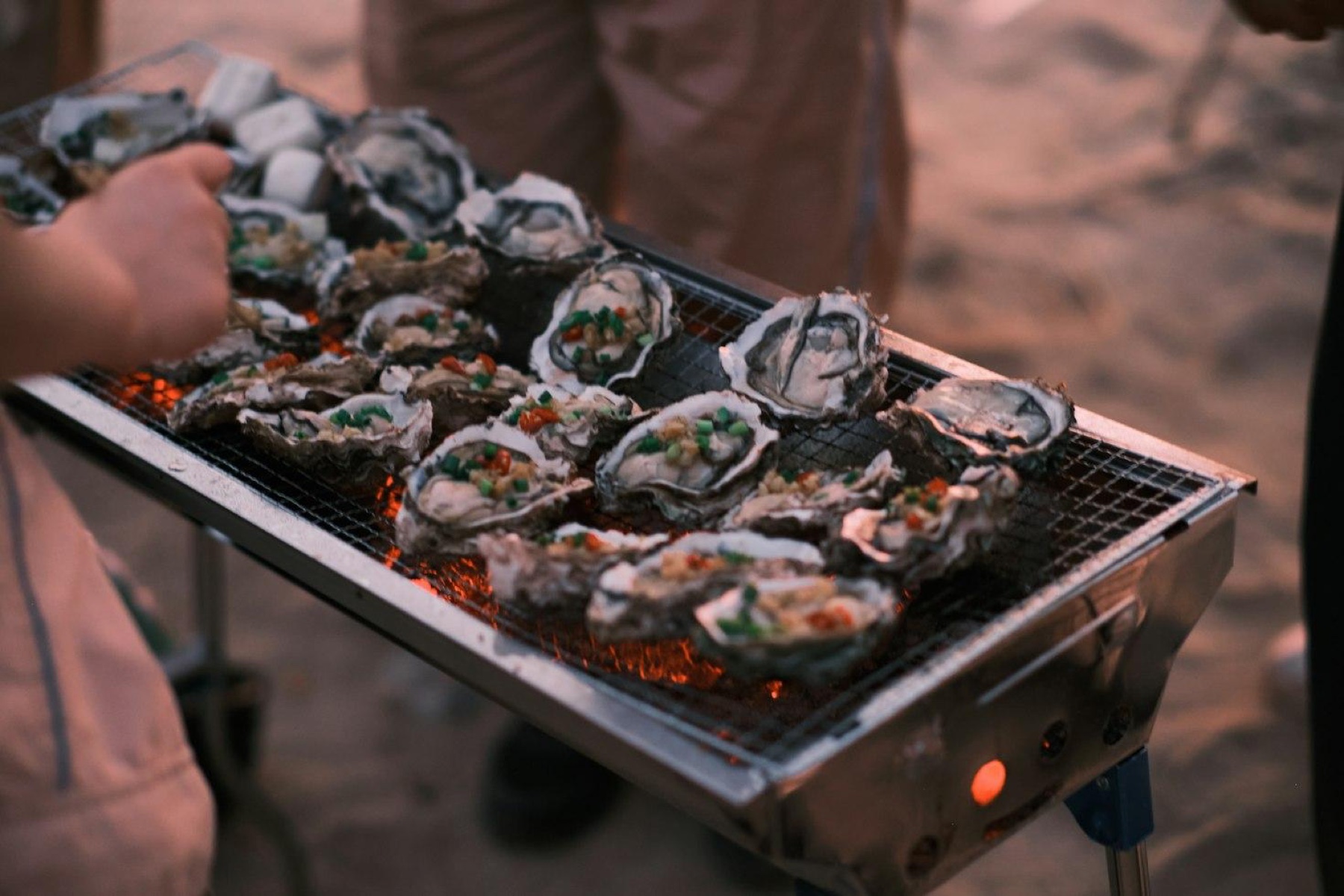
Example of oyster preparation scene. This photo does not represent the specifications or safety of cooked products. It is a stock photo for illustrative purposes and does not serve as proof of Samsam Moolsan’s products, facilities, certifications, or Korean-sourced ingredients.
Photo: LI WEIBIN / Unsplash · License
How Do They Differ from Raw and Raw Frozen Oysters?
|
Product |
Heat Treatment Status |
Preservation/Form |
Usage Method to Verify |
|
Raw Oysters |
Not Heated |
Refrigerated |
Indication for Raw Consumption/Cooking |
|
Raw Frozen Oysters |
Not Heated |
IQF or Block Frozen |
Required Heating After Freezing |
|
Cooked Oysters |
Heated |
Refrigerated or Frozen |
RTE or Additional Heating Indication |
The Codex standard for live bivalve molluscs describes the product scope that maintains raw characteristics even after shucking and freezing.[4] As this standard pertains to raw products, it cannot solely determine the processing or consumption use of cooked products.
Heat treatment and freezing methods must also be considered separately. Cooked oysters can also be IQF. Like the selection criteria for raw/cooked and IQF/block, first determine the heat treatment status, then choose the freezing method based on the unit of use. If terminology is confusing, you can refer to the meaning of IQF.
Are all cooked oysters ready-to-eat products?
No. ‘Cooked’ refers to the heating history, while ‘RTE’ refers to the final intended use, typically consumed without further hazard reduction processes.[3] FDA guidance also explains that the presence of heated ingredients does not automatically make the final product RTE.[2]
The RTE status of purchased products is determined by cross-referencing the following information:
- Purpose and scope of hazard reduction verification for the heating process
- Management of recontamination during cooling, sorting, and packaging after heating
- Intended use in the finished product specification
- Label instructions for immediate consumption or additional heating
The food type must also be verified for each product. The 2018 MFDS guidance provides classification examples for imported cooked frozen clams/mussels,[1] but it cannot be applied to all oyster SKUs. Verify the current product’s food type, process, and labeling. The position of the cooking branch in the overall process can be compared in the Oyster Processing Branch Guide by Product.
Connecting Purchase Specifications with Menu Testing
When inquiring about the degree of cooking from suppliers, specifically request the verified scope of time-temperature processes, cooling and packaging, RTE status, and heating instructions. For frozen products, compare IQF/block, size, net weight/glaze, and thawing yield. Refer to Thawing Drip of Frozen Seafood to distinguish between glaze meltwater and tissue drip.
Menu testing involves recording cooking time, shrinkage, texture, drip, and final weight under identical thawing, input, and heating conditions. Thaw according to product instructions and avoid prolonged exposure to room temperature/hot water and repeated freezing/thawing.[5]
When inquiring about supply from Samsam Moolsan, please provide information on raw/cooked status, RTE or additional heating use, IQF/block form, single input quantity, monthly usage, size/net weight/glaze, and menu test conditions. Actual supply specifications and transaction terms must be confirmed upon inquiry.
Frequently Asked Questions
Can cooked oysters be served immediately after thawing?
Do not decide based solely on the ‘cooked’ label. Verify the intended use in the specification, heating instructions on the label, and the scope of hygiene management after heating. If it requires additional heating, apply the specified cooking process.
Can cooked oysters be supplied in IQF or block form?
Yes, this is possible in terms of product form. ‘Cooked’ refers to the heat treatment status, and IQF/block refers to the freezing method, so they can be applied together. After determining raw/cooked status, choose based on batch usage and thawing unit, but the actual supply form must be confirmed per SKU.
What information confirms whether additional heating is required?
Cross-reference the intended use in the specification with the cooking instructions on the label, process flow, and heating verification scope. If the intended uses differ between documents, confirm before placing an order.
What do we compare raw frozen oysters with in menu testing?
Under the same conditions, record cooking time, core heating, shrinkage, texture, drip, and final weight. You cannot assume a higher yield based solely on whether it is cooked.
To what extent should the process data for cooked products be verified?
Connect the verification purpose of heating time/temperature, cooling, post-heating sorting/packaging, recontamination control, lot records, and deviation handling. If it is RTE, the final use and labeling should also describe the same process.
Sources and Verification Criteria
[1] Notification on Product Classification Guidance for Imported Cooked Frozen Aquatic Products
https://www.mfds.go.kr/brd/m_767/view.do?seq=32070&srchFr=&srchTo=&srchWord=&srchTp=&itm_seq_1=0&itm_seq_2=0&multi_itm_seq=0&company_cd=&company_nm=&page=9
Products such as clams and mussels frozen after cooking are subject to separate classification review · Verified on 2026-09-27
[2] Fish and Fishery Products Hazards and Controls Guidance, Chapter 12
https://www.fda.gov/food/seafood-guidance-documents-regulatory-information/fish-and-fishery-products-hazards-and-controls
Distinction that a final product is not automatically ready-to-eat even if it contains heated ingredients · Verified on 2026-09-27
[3] 21 CFR 117.3 Definitions
https://www.ecfr.gov/current/title-21/chapter-I/subchapter-B/part-117/subpart-A/section-117.3
Definition of ready-to-eat as food typically consumed without further hazard reduction processes · Verified on 2026-09-27
[4] Standard for Live and Raw Bivalve Molluscs (CXS 292-2008, amended 2026)
https://openknowledge.fao.org/bitstreams/3f8dcfaf-2909-43df-b707-2fa5a3def13f/download
Product scope of live and raw bivalve molluscs, distinction between direct consumption and further processing, weight distinction for glazed and block products · Verified on 2026-09-27
[5] Tips for Purchasing and Storing Seafood
https://www.foodsafetykorea.go.kr/portal/board/boardDetail.do?bbs_no=bbs160617&menu_grp=MENU_NEW01&menu_no=4846&ntctxt_no=1096183
Refrigerated/microwave thawing, avoiding prolonged exposure to room temperature/hot water and repeated freezing/thawing · Verified on 2026-09-27