Oyster & Seafood Glossary
GLOSSARYTerms that appear on product sheets and purchase orders but are rarely explained anywhere. We keep adding entries.
What is Thaw Drip? Why Frozen Seafood Loses Moisture
Thaw drip (drip loss) refers to the water and water-soluble components that leak out of the tissue when frozen seafood is thawed. Since the liquid collected in the packaging may also contain melted surface glaze or water added during processing, calculating the total amount as tissue drip can lead to confusion between the labeled weight and the actual usable yield.
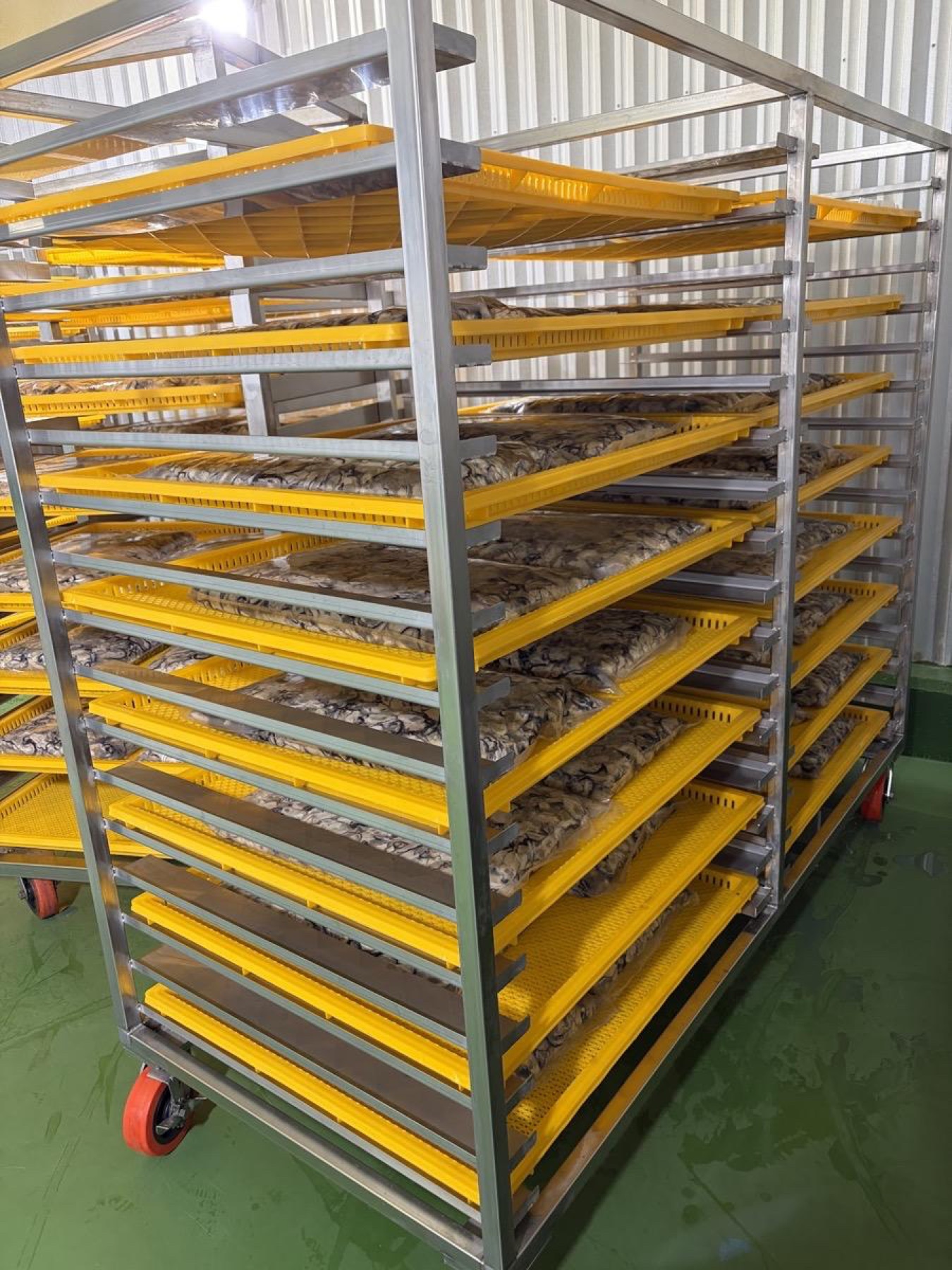
The thawing stage of the Eoriguljeot (salted and fermented oyster) manufacturing process provided by Samsam Co., Ltd. This is not test data proving specific thawing conditions or drip/yield figures.
Photo credit: Samsam Co., Ltd. · Original provided by the company
Causes of Drip and Scope of Interpretation
When moisture in seafood freezes, ice crystals form, and salts and proteins become concentrated in the remaining liquid. If the freezing rate is slow or storage temperatures fluctuate, ice crystal growth, protein changes, and tissue damage increase, which can weaken the ability to retain moisture during thawing.[1][2] However, drip is influenced by a combination of raw material condition, pretreatment, storage period, packaging, temperature history, and thawing/weighing conditions. Because so many factors are involved, an IQF label alone is not enough to guarantee low drip. The section on Differences between IQF and Block Freezing explains the distinctions in freezing formats and units of use.
Distinguishing Three Types of Water and Test Objectives
|
Classification |
Source Location |
Related Assessment |
|
Glaze Meltwater |
Surface Protective Ice Film |
Labeled Net Weight Test |
|
Tissue Drip |
Inside Oyster Tissue |
Thaw Yield and Quality Changes |
|
Wash/Thaw Water |
Water Added During Processing |
Consistency of Test Conditions |
Domestic guidelines for testing the content of frozen seafood also advise caution to prevent product drip from escaping when removing the ice film.[3] Use the weight in a frozen state after removing the glaze to review the labeled net weight, and use the weight after complete thawing and draining to evaluate the usable amount after processing. Do not substitute these two values for each other.
Record Thaw Yield Along with Test Conditions
Thaw yield can be calculated as: ‘Weight after thawing and draining under identical conditions ÷ Reference weight after glaze removal × 100’. For example, if the reference weight is 1,000g and the weight after thawing and draining is 910g, the yield for that test is 91%. The 90g difference may be affected by residual surface water or handling loss, so it should not be assumed to be entirely tissue drip.
- Product name, lot number, and starting weight
- Glaze removal method and weight after removal
- Thawing temperature/time, container, and sample arrangement
- Sieve specifications, drainage time, and whether compression was applied
- Weight after thawing/draining and, if necessary, weight after cooking
Test candidate products under the same conditions and compare them based on the usable amount, as shown in the Cost Calculation in the Frozen Oyster Selection Guide. If the product is insufficiently thawed or if surface water/ice film remains, the value may appear higher; therefore, record damage, shrinkage, aroma, and cooking yield as well. A high yield does not necessarily confirm safety. Thawing is not a sterilization step, and safety or quality cannot be determined by the amount of drip alone. When testing, follow the handling instructions on the product label, such as refrigerated thawing, and avoid leaving the product at room temperature or in warm water for long periods, as well as repeated freezing and thawing.[4]
When inquiring about supply from Samsam Co., Ltd., please let us know the required product format and target usage amount. If you have conducted comparative tests, please provide the lot number, glaze removal method, thawing temperature/time, sieve/drainage conditions, weight at each stage, and cooking method. Actual supply specifications and transaction terms must be confirmed at the time of inquiry.
Frequently Asked Questions
Is all the water that comes out during thawing considered tissue drip?
No. Glaze meltwater and water added during processing may be mixed in. Please record the generation stage and weighing point separately.
Is a product with less drip always of better quality?
Not necessarily. If the product is insufficiently thawed or surface water remains, the weight will appear high. Consider damage, shrinkage, aroma, cooking yield, and temperature history together.
Can I compare yields using different thawing methods for each sample?
It is difficult to compare. Temperature, time, containers, sieves, drainage time, and whether compression is applied must be identical to interpret the differences in test values.
Can the weight after thawing and draining be considered the labeled net weight?
They are not the same value. The labeled net weight is reviewed at the glaze removal stage. The weight after thawing and draining is used to evaluate the usable amount and yield under those specific test conditions.
What records should be shared with the supplier if a yield difference occurs?
Please share reproducible data such as product/lot, starting weight, weight after glaze removal, weight after thawing/draining/cooking, thawing temperature/time, sieve/drainage conditions, and photos.
Sources and Verification Standards
[1] Freezing and refrigerated storage in fisheries: Influence of temperature
https://www.fao.org/4/v3630e/v3630e03.htm
Principles of rapid freezing, IQF unit freezing, ice crystal/protein changes, and thawing quality · Accessed 2026-09-27
[2] Freezing and refrigerated storage in fisheries: Weight loss from fish during freezing and cold storage
https://www.fao.org/4/v3630e/v3630e10.htm
Relationship between dehydration/weight loss during freezing/storage and thaw drip/quality changes · Accessed 2026-09-27
[3] Expiration Date and Weight Labeling of Frozen Seafood
https://www.fsis.go.kr/front/contents/cmsView.do?cate_id=0101&cnts_id=18663&select_list_no=2
Checking ice film content and frozen seafood content, testing principles to avoid drip loss · Accessed 2026-09-27
[4] Tips for Purchasing and Storing Seafood
https://www.foodsafetykorea.go.kr/portal/board/boardDetail.do?bbs_no=bbs160617&menu_grp=MENU_NEW01&menu_no=4846&ntctxt_no=1096183
Refrigerated/microwave thawing, avoiding room temperature/warm water exposure and repeated freezing/thawing · Accessed 2026-09-27