Oyster & Seafood Glossary
GLOSSARYTerms that appear on product sheets and purchase orders but are rarely explained anywhere. We keep adding entries.
What is Glazing? Ice Glaze and Weight Labeling of Frozen Seafood
Glazing is a process that creates a thin ice glaze on the surface of frozen seafood by spraying or contacting it with water. In Purchasing and QA, it is essential to distinguish between the gross weight (including glaze), net weight after glaze removal, and usable weight after thawing and draining.
What Does Glazing Do, and What Does It Not Do?
The FAO explains that glaze sublimates before the product and reduces air contact, slowing dehydration and oxidation during freezing.[1] For products with significant surface exposure, this protective function should also be considered. It can be reviewed in conjunction with the characteristics of IQF products. However, it is not a sterilization or indefinite preservation method. Glaze thickness varies depending on the product and water temperature, contact time, and form, while packaging damage and temperature fluctuations require separate management.[1]
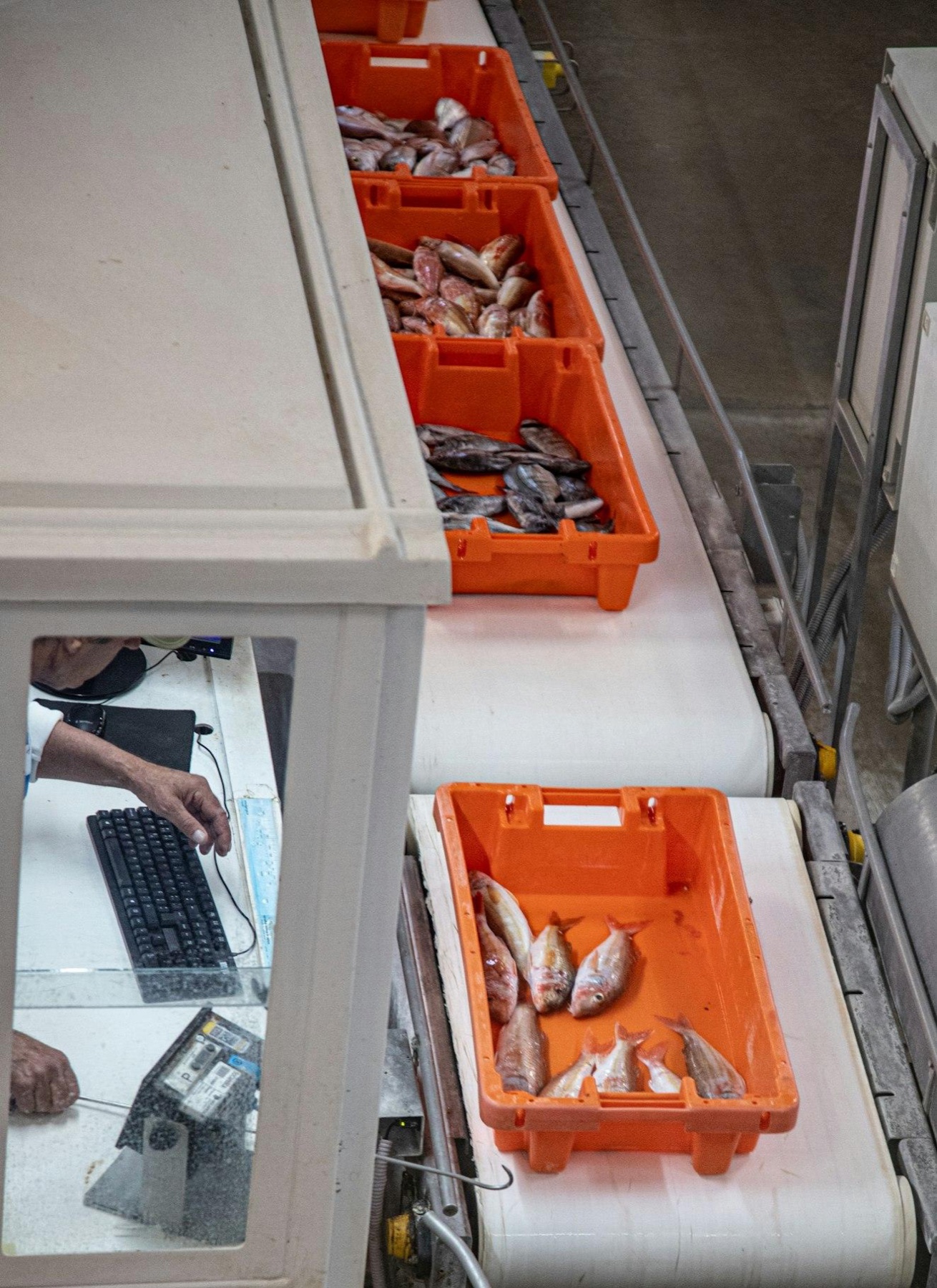
Scene of seafood weight verification. Net weight and glaze evaluation for oysters are subject to separate testing conditions. This is a stock photo for illustrative purposes and does not prove Samsam Moolsan’s products, facilities, certifications, or Korean origin.
Photo: Bernd Dittrich / Unsplash · License
Distinguish Three Types of Weight
|
Item |
Meaning |
Comparison Use |
|
Gross Weight (including glaze) |
Sum of product and surface ice glaze |
Reference value for incoming condition |
|
Net Weight After Glaze Removal |
Product quantity after glaze removal by a defined method |
Verification of declared net weight |
|
Usable Weight After Thawing and Draining |
Quantity available for use after complete thawing and draining |
Calculation of yield and cost |
Codex guidelines and U.S. FDA guidance establish the principle that glaze weight should not be included in the net weight of frozen seafood.[2][5] Korea’s Food Safety Information Service also distinguishes between weight including ice glaze and actual net content.[3] When reviewing domestic labeling, it is necessary to check the latest official notices at the time of sale.[4] The net weight after glaze removal and the usable weight after thawing and draining are different, with the latter also affected by thaw drip from the tissue.
Glaze percentage is read under the same testing conditions
As a hypothetical example, if a glazed sample weighs 1,000g and, after removing only the ice glaze by a defined method, it weighs 880g, then the removed ice is 120g. A simple calculation using the incoming sample weight as the denominator is 120 ÷ 1,000 × 100 = 12%.
This percentage is a value explaining the calculation structure and is not a legal or contractual judgment value. Actual tests yield different results depending on the denominator, water temperature, contact/draining conditions. Prolonged immersion can mix glaze meltwater and tissue drip.[3] Candidate products should be compared under the same removal, thawing, and draining conditions, such as in the frozen oyster order comparison table.
Connect ice inside packaging with lot judgment
There is a difference between a relatively uniform ice glaze intentionally formed on the product surface and frost or large ice crystals inside the packaging. If large crystals or clumps are observed, check for temperature fluctuations, but do not judge solely by appearance. Packaging, arrival temperature, and transport/storage records must be cross-referenced with acceptance criteria.
When inquiring about supply from Samsam Moolsan, please provide the product form, declared net weight, glaze standard, desired packaging unit, monthly usage, and the removal, thawing, and draining conditions and tolerances to be applied. Actual supply specifications and transaction terms must be confirmed upon inquiry.
Frequently Asked Questions
Does glazing mean the product is of lower quality?
Not necessarily. Glaze can be a protective barrier that slows dehydration and oxidation.[1] It is not a measure of sterilization or quality grade, so consider uniformity, net weight, and packaging and storage history together.
Can I compare quotes based on the gross package weight including glaze?
If you only look at the gross weight, the ice glaze might be calculated as product quantity. Convert unit prices based on the same declared net weight and packaging unit, and confirm the testing method and tolerances.
Are net weight after glaze removal and thaw yield the same value?
No. Net weight after glaze removal is the quantity of the product, while thaw yield is the ratio of the usable quantity after complete thawing and draining to a defined standard weight. Record glaze meltwater and tissue drip separately.
Can glaze percentage be compared solely based on the supplier’s explanation?
To compare, you need to know not only the percentage but also the calculation denominator, number of samples, water temperature, contact/draining time, and the scale used. If conditions differ, even the same lot can have different comparison values.
What conditions should be agreed upon to reduce disputes over delivery weight?
Record the weighing time, glaze removal method, sieve size and draining time, scale management, number of samples, tolerances, and procedures for handling non-conforming lots in the specification, purchase order, and incoming inspection sheet using consistent wording.
Sources and Verification Criteria
[1] Freezing and refrigerated storage in fisheries: Treatment of fish after freezing
https://www.fao.org/4/v3630e/v3630e07.htm
Definition of glazing, purpose of inhibiting dehydration and oxidation, importance of managing uniform ice glaze · Verified on 2026-09-27
[2] Code of Practice for Fish and Fishery Products (CAC/RCP 52-2003)
https://www.fao.org/input/download/standards/10273/CXP_052e.pdf
Process control for frozen seafood, purpose of glazing and principle of excluding net weight · Verified on 2026-09-27
[3] Shelf life and weight labeling of frozen seafood
https://www.fsis.go.kr/front/contents/cmsView.do?cate_id=0101&cnts_id=18663&select_list_no=2
Verification of ice glaze content and net content of frozen seafood, testing principle to avoid drip loss · Verified on 2026-09-27
[4] 「Food Labeling Standards」 Notification No. 2019-97
https://www.mfds.go.kr/brd/m_211/view.do?seq=14378
Clarification of ice glaze definition and labeling method for net content of ice-glazed foods · Verified on 2026-09-27
[5] Guidance for Industry: Including Glaze as Part of the Weight of Frozen Seafood
https://www.fda.gov/food/guidance-documents-regulatory-information-topic/guidance-industry-1991-letter-seafood-manufacturers-regarding-fraudulent-practice-including-glaze
Principle of not including ice glaze weight in the net weight of frozen seafood · Verified on 2026-09-27